Look at His Sleeves
Guess what your subscriptions cost you each month, then check. The Joker shows you how the trick is done, gear by gear, from the free trial to the sad dog on the cancel page.
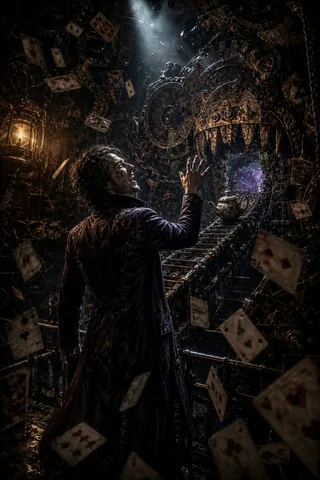

Let me show you a magic trick.
Take out your bank statement. Go on, the real one, last month's. Now find every line that says the same amount, on the same day, to the same company you can't quite picture. The film one. The music one. The one for the app you used twice in March. The cloud storage you bought when your phone was full and never thought about again. The meal kit you paused, or thought you paused. The premium tier of something you're fairly sure you already had the free tier of.
Count them up.
Now, here's the trick: before you count, guess. Say a number out loud. How much do you think all of that comes to, each month?
Got your number? Good. Hold on to it. We'll come back to it, and when we do, you'll be very impressed with the magician. Because the magician isn't me. The magician is the machine, and the trick is that you've been paying it for years without being able to say how much.
The reveal
In a 2022 survey of 1,000 US adults by C+R Research, people's ten-second guess at their monthly subscription spending averaged $86. When they sat down and added it up, the real figure averaged $219: $133 more than they thought, close to $1,600 a year. Forty-two percent said they'd forgotten about a subscription they were still paying for. (reported by NBC)
Ta-da.
Eighty-six dollars, said the audience. Two hundred and nineteen, said the statement. And nearly half of them were paying for something they'd forgotten existed.
Now, a lesser magician would stop there and take a bow. I'm going to do something much more fun. I'm going to show you how the trick is done. Gear by gear. Because once you've seen the gears, the trick stops working, and there's nothing a machine hates more than a trick that stops working.
First gear: the free trial
Every good trick begins with a gift.
Try it free for thirty days. No cost. No commitment. Cancel anytime. Who could object? It's free. Free is the friendliest word in the language. Nobody ever got hurt by free.
Except, notice what they asked you for. Your card. Why does a free thing need your card?
Because the trick isn't the thirty days. The trick is day thirty-one. They aren't betting that you'll love the product. They're betting that you'll forget. Forgetting is the business model. A thing you'd happily pay for doesn't need you to hand over your card in advance, because you'd hand it over gladly at the end. The card up front is for the version of you who doesn't remember.
That's the first gear. It's tiny. It's polite. It smiles at you. It turns your memory into revenue.
Second gear: the renewal you don't see
The free trial ends. Your card is charged. And then, here's the clever bit, it's charged again. And again. Every month, on the same day, quietly, without anyone asking you a single question.
Think about how strange that is. If a man came to your door every month and said, Hello, I'm here for the fourteen ninety-nine, you'd at least ask him what for. You'd say, hang on, do I still use that? The door would give you a moment to decide.
The renewal takes the door away. Nobody knocks. The money just leaves. And because it leaves the same way every month, the same amount, the same day, your brain files it under weather. It's just something that happens. You don't decide to pay it any more than you decide to have Tuesday.
That's the second gear. It turns a choice into a habit, and a habit into scenery. Very hard to cancel scenery.
Third gear: the price that creeps
Now that it's scenery, watch what happens to the price.
It goes up. Not much. Never much. A dollar here. Two there. We're making some changes to your plan to keep bringing you the content you love. The email arrives, you don't open it, or you open it and sigh and close it. Fourteen ninety-nine becomes fifteen ninety-nine becomes seventeen ninety-nine.
Here's the thing about a price that creeps. You'd never have agreed to seventeen ninety-nine on day one. If the first page had said seventeen ninety-nine, you'd have thought about it. But you never get asked about seventeen ninety-nine. You get asked about fifteen ninety-nine, after you'd already said yes to fourteen ninety-nine, and the only question on the table is whether one dollar is worth the trouble of leaving.
One dollar is never worth the trouble of leaving. That's how they get to seventeen ninety-nine. One dollar at a time, each one too small to fight.
That's the third gear. It never asks you for the big number. It just keeps asking you for the small one.
Fourth gear: the exit with no sign
So one day you've had enough. You decide to cancel. Good for you. Let's watch.
You open the app. There's a big friendly button to upgrade. There's a big friendly button to add a family member. There's a big friendly button to try the premium tier free for thirty days, and we know where that goes.
The cancel button is somewhere else.
It's in settings. No, account. No, the account on the website, not in the app. It's under manage plan, which is under billing, which is under your profile, which you can only reach after you log in again, and you've forgotten the password, so you reset the password, and now you're on a page that says We're sorry to see you go! with a cartoon of a sad dog, and below the dog is an offer for half price for three months, and below that is a question about why you're leaving, and below that, in small grey letters, finally, is continue to cancel.
And when you press it, they ask you if you're sure.
Notice the shape of that. Joining took one tap. Leaving took eleven, and a sad dog. That's not an accident. That's architecture. Somebody, somewhere, measured how many people give up at each step of the cancellation, and kept every step that made people give up.
That's the fourth gear, and it's my favourite, because it's the most honest. It tells you exactly what the machine values. Getting you in: easy. Letting you out: difficult. If a door is easy to walk into and hard to walk out of, it isn't a door. It's a trap with good branding.
Fifth gear: owning nothing
Now step back and look at the whole machine, because there's a bigger gear behind all the little ones.
You used to buy things. A record. A book. A film on a disc. You paid once, and then it was yours, and it sat on your shelf, and nobody could come round in the night and take it back.
Now you rent almost everything. Your music isn't yours. Your films aren't yours. Your software isn't yours; it lives on someone else's computer, and you pay a monthly fee to be allowed to use it. A few years ago one carmaker even tried charging some drivers by the month to switch on heated seats that were already built into the car. It didn't last. I couldn't have made that up if I'd tried.
And here's the gear: when you rent everything, you never finish paying. A thing you own costs you once. A thing you rent costs you forever. Every month for the rest of your life, the meter runs. Stop paying, and it all disappears: the music, the films, the documents, the photographs of your children you forgot were in the cloud.
The machine didn't just find a way to charge you. It found a way to charge you for the rest of your life, for things you'll never get to keep.
Why this one's funny
Now, I promised you a laugh, and here it is.
The machine is terribly proud of itself. It talks about convenience and flexibility and access. It says you're free now, free from clutter, free from ownership, free to cancel anytime.
But look at what it actually built. A system where a grown adult cannot tell you, within a hundred and thirty dollars, how much they pay it every month. Where nearly half the customers are paying for something they've forgotten. Where joining takes one tap and leaving takes a sad dog.
That's not freedom. That's a vending machine that keeps your hand.
And the funniest part? The machine has convinced us that this is the grown-up way to live. That the person with nine subscriptions is modern and the person with a shelf of records is a dinosaur. When really, from where I'm standing, the person with the shelf of records is the only one in the room who knows what they own.
What it's actually charging you for
I'll put the grin away for one paragraph, because there's a point underneath this that isn't funny.
The books in this House rest on a simple claim. Your worth started with your first breath. Nobody can add to it and nobody can take it away. You don't have to earn it, and you certainly don't have to rent it.
The subscription machine runs on the opposite idea. It whispers that to have a good life, you have to keep paying for one, monthly, forever. Your entertainment, your tools, your memories, your comfort, all on a meter. Stop paying and you lose it. Which, if you think about it, is a little sermon about worth: that you're only worth as much as you're currently paying for. That a life is something you lease.
That's the gear I'd most like you to see. Not the free trial. Not the sad dog. That one. The idea that your life is a service you subscribe to. It isn't. It came with the breath, and the breath was free.
The smallest move that breaks it
Right. Grin back on. Here's how you break it, and it's so small you'll laugh.
Tonight, before bed, get your statement and a pen. Write down every subscription. All of them. Every line that repeats. Next to each one, write one word: yes or no. Yes if you used it this month and you'd pay for it again today, at today's price, if someone knocked on your door and asked. No if you wouldn't.
Then cancel every no. Not all at once if it's too much. Just one, tonight. The smallest one. Find the sad dog, look it in the eye, and press continue.
That's it. That's the whole move.
Here's why it works. The machine depends on you never doing that list. Every gear I showed you, the free trial, the silent renewal, the creeping price, the hidden exit, only turns because you never sit down and look at the whole thing at once. The moment you do, the trick's over. You've seen the magician's sleeve.
And then, here's the bonus round: put a reminder in your calendar for six months from now that just says the list. Do it again then. The machine will have slipped a couple of new ones in by then; it always does. That's fine. You're not trying to beat it forever. You're just trying to be the one who knows.
Curtain
So. Remember the number you guessed at the start? The one you said out loud?
Go and check it. Add up the real one.
If it's close, congratulations, you're a better magician than most of the audience. If it's not, if it's a good deal higher, don't feel stupid. You were watching a very good trick, performed by a machine that's been practising on millions of people for years.
But now you've seen how it's done.
And a trick you've seen how it's done is just a man in a cape, standing in the light, hoping you won't look at his sleeves.
Look at his sleeves.