Quiet, Sold Separately
Noise is free now and quiet costs money. The Cheshire counts the ears on a morning train and finds the door everyone walked past: the same hand that turns up the volume sells you the earplugs.
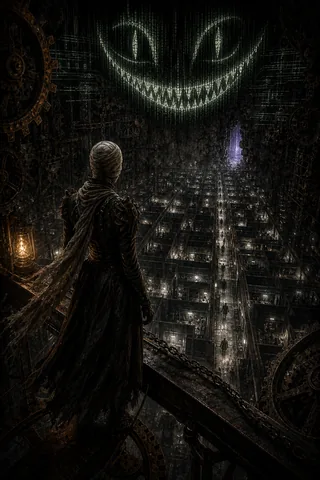

Look at the people on any train in the morning and count the ears.
Go on. Next time you're on one, count. You'll find that most of the ears are plugged. Little white buds, big padded cups, wires running into pockets. And if you watch closely, you'll notice that a good number of them aren't playing anything at all. People put them in and switch on the setting that makes the world go away, and then they sit there in a soft, expensive silence, looking at nothing.
I find that very interesting. I watched it for a long time from the beam.
What they've bought, those people, isn't music. It's quiet. And quiet, it turns out, is something you now have to buy.
Says who?
I'd like to start with the question I always start with. Says who?
Who decided that quiet should cost money?
Because it didn't, for most of history. Quiet was the default. It was what you had when nothing else was happening, which was most of the time. You didn't have to go and get it. You had to go and get noise: a fair, a market, a pub on a Friday. Quiet was free and plentiful and so ordinary that nobody thought to put a price on it.
Now it's the other way round. Noise is the default. It's free, and it comes to you whether you asked for it or not. The shop plays music. The petrol pump has a screen on it that talks to you while you fill up. The lift has a television. The waiting room has a television. The taxi has a television in the back of the headrest, and it starts playing adverts the moment you sit down, and you have to find the little button to turn it off, and sometimes there isn't one.
And quiet? Quiet is a product now. A premium product. You pay for the headphones that cancel the noise. You pay for the quiet carriage on the train. You pay extra for the lounge at the airport where there's no announcement every forty seconds. You pay for the app that plays you the sound of rain so you can't hear the sound of everything else. You pay for the retreat where they take your phone off you for a weekend and charge you for the privilege.
That's the door you walked past. Here. I found it.
The two invoices
Look at it from up here and you'll see a neat little arrangement.
The noise is sold to someone else. Every screen at the petrol pump, every advert in the taxi, every jingle in the shop, is there because someone paid to put it in front of you. You're not the one buying the noise. You're the one it's aimed at. Your attention is what's being bought, by whoever's paying for the screen.
The quiet is sold to you. You're the one who pays for the headphones, the carriage, the lounge, the retreat.
So you pay twice. Once with your attention, to the people who fill the world with noise. Then again with your money, to the people who'll sell you a way out of it. And sometimes, and this is the part I find funniest, they're the same people. The same companies that make the devices that ping at you all day also make the headphones that let you not hear the pinging. One hand turns up the volume. The other hand sells you the earplugs.
You have to admire it, a bit. It's a very tidy machine.
Who gets the quiet
Here's something I noticed, sitting up here, that took me a while to see.
Quiet has become a thing that rich people have.
Not entirely. But look at where the quiet is. It's in the expensive seat at the front of the plane. It's in the house with the big garden, set back from the road. It's in the office with a door, rather than the open floor with ninety desks and someone on a sales call three feet away. It's in the car with good insulation, the hotel with thick walls, the neighbourhood without a motorway running through it.
And look at where the noise is. It's in the cheap seats. It's in the flat above the shop, on the main road, under the flight path. It's in the open-plan office, the call centre, the warehouse floor. It's in the job where you can't put headphones in because you have to hear the next customer, the next alarm, the next instruction.
So the people with the least money get the most noise, and the people with the most money buy the most quiet. And quiet, it turns out, isn't a luxury in the way a nice watch is a luxury. It's closer to clean air. Your body needs it. Your mind needs it to think a thought all the way through. Without it, people get tired in a way that sleep doesn't fix.
If you live in the noise, you're not imagining it. It really is wearing you down. And it really is, partly, because of where you can afford to live.
What the noise does
Let me stay on the ground for a minute and talk about what happens to a person in the noise, because I think a lot of people blame themselves for it.
You can't concentrate. You start a thought and lose it halfway. You read the same paragraph three times. You feel scattered, jumpy, short-tempered. You snap at someone over nothing. In the evening, when it finally goes quiet, you can't settle; you reach for the phone, or the television, because the silence itself feels strange, almost uncomfortable, like a room after a party when everyone's gone.
And you think: there's something wrong with me. I can't focus. I'm not disciplined. Other people can read a whole book.
But other people, often, aren't living under the noise. Concentration isn't only a virtue. It's partly a condition. You can't grow a thought in soil that's being dug up every forty seconds. Nobody could. The people who seem to have more focus often just have a door that closes.
So, gently, from the beam: it may not be you. It may be the room.
The quiet that can't be sold
Now I want to show you a different door, because I don't like leaving people with nothing but a wall.
There's a kind of quiet you can buy. The headphones, the lounge, the retreat. It's real, and some of it's lovely, and I won't tell you not to buy it if it helps.
But there's another kind that can't be bought, which is exactly why nobody advertises it.
It's the quiet you make by not putting something on. The walk without the headphones in. The ten minutes after you wake up, before you pick up the phone. The drive home with the radio off. The cup of tea drunk sitting down, looking out of the window, with nothing playing.
At first, it'll feel wrong. That's the strangest thing about quiet now. People have been in the noise for so long that silence feels like something's missing. They reach for something to fill it out of pure reflex, the way your hand goes to a pocket for keys you've already got.
If you sit through that, though, if you let the strangeness pass, something happens. Your own thoughts come back. Not the urgent ones, not the to-do list. The slow ones. The ones that were waiting for a gap. You remember something you'd forgotten. You notice the light on the wall. You have an idea, a small one, the kind that only turns up when nothing else is talking.
That's the quiet nobody can sell you. It was always yours.
Who you are in the quiet
There's one more thing, and it's the part I care about most, even if I'll only say it once and then fade.
In the noise, you're a target. Every screen, every jingle, every ping is trying to reach you, to make you look, to make you want. You're the thing being aimed at. That's a tiring way to be, all day, every day: a target for other people's purposes.
In the quiet, you're nobody's target. Nothing is trying to reach you. And in that moment you get to find out what you are when nobody's selling you anything.
The books in this House rest on a premise, and it's very simple. Your worth started with your first breath. It doesn't come from being looked at. It doesn't come from being sold to. It's there in the noise and it's there in the quiet. But it's much easier to hear it in the quiet, because in the quiet, nothing's shouting over it.
Three doors
I'll leave you with a few doors. Walk through one, or none. They'll still be there.
Count the noise you didn't ask for. For one day, just notice every sound that was put in front of you by somebody who wanted your attention. The screen at the pump, the advert in the lift, the notification. You don't have to do anything about them. Just count. You'll be surprised how many there are, and how few you chose.
Make ten minutes of free quiet. Not bought. Free. Ten minutes in the day with nothing playing and nothing in your hands. First thing in the morning is easiest, before the noise starts. Notice what thoughts come when they're allowed to.
And next time someone tries to sell you quiet, ask my question. Says who? Who made it noisy in the first place? You might still buy the headphones. Just buy them knowing who turned up the volume.
The door you walked past
So here it is, on the doorstep.
Everyone's arguing about whether we're too distracted, whether attention spans are shrinking, whether anyone can concentrate anymore. That's the door everyone's staring at.
Nobody's asking who made the world so loud, or who's selling the silence back.
Quiet was free once. Some of it still is. It's in the ten minutes before the phone, the walk without the music, the cup of tea at the window. Nobody will invoice you for it. That's the only reason nobody tells you it's there.
My question for tomorrow, and then I'll go:
When did you last hear your own thoughts with nothing else talking?
If you can't remember, that's not a failing. It's information. Do with it what you like.